Which Is Correct
From cancel culture to cancelled flights, the discussion 'cancel' tin can present itself in different means, depending on the context. Writers of all levels have struggled with words like this. Permit'south get into the details on the difference between cancelled and canceled and when to use them.
Canceled or Cancelled?
Canceled, with one 50, is used in American English language, and cancelled, with two L'southward, is preferred in British English language and outside of the U.S.
Why Cancelled and Canceled are Dissimilar
Cancelled and canceled are just different in spelling and origin. Obviously, one word has a double L, while the other only has one. But the most significant departure between them is that cancelled is British English, while canceled is American English.
So, what's the logic behind American English'due south use of a unmarried L? In the 19th century, Noah Webster of the Webster's Dictionary thought some words kept their value with a alphabetic character removed.
Even with a simplified spelling, canceled even so sounds and means the same every bit cancelled. The same is accurate with other American spellings, like honor/honour and color/colour.
Cheers to Noah Webster's dictionaries, these American spellings became official. However, these orthographic variations were already present before.
The present progressive form of the verb may also use single or double Fifty. This means canceling and cancelling are too acceptable.
When to Use Canceled vs. Cancelled
Spelling variations of the same word can be confusing. Like, authorise vs authorize, or apologise vs apologize.
Use canceled when writing in American English, and utilize cancelled for British English. Don't get confused near their definitions because they are the aforementioned. Cancelled and canceled come from the simple verb form, cancel, which ways:
- To annul, make void, or revoke. East.g., She canceled/cancelled her transaction.
- To phone call off an event or occurrence. Due east.1000., My sis's flight was canceled/cancelled.
- To compensate for one another. E.chiliad., Our opposing votes always cancel each other.
Hither are other examples that use American English and British English in a sentence:
- Allan canceled our reservation because I already had dinner.
- Allan cancelled our reservation because I accept already had dinner.
Hither's a bonus lesson, which you'll find helpful subsequently: American English unremarkably uses elementary by tense. And British English uses present perfect tense.
Other words with spelling differences that follow the same guideline include modeled and modelled and bejeweled and bejewelled.
More American Examples
Take a look at these other American examples of canceled and canceling in a judgement:
Many flights have been canceled, forcing more passengers to connect at big and increasingly crowded hubs. [New York Times]
Under current law, it is scheduled to ascension to 6.eight% on July 1, an increase that Obama has called for canceling. [Los Angeles Times]
Moriarty added that an before cancellation could have allowed the slot to be resold, which would have resulted in a credit being issued. [Boston Earth]
But there'due south a catch. Some verbs that terminate in 50 employ a double L for their American past tense. Here are some examples:
- Rebel, rebelled, and rebelling.
- Compel, compelled, and compelling.
- Enrol/Enroll, enrolled, and enrolling.
- Dispel, dispelled, and dispelling.
If you want to know whether you should double the L or non, try to pronounce the word. If the final syllable is heavy, a double L is the preferred spelling. If not, use single L. Some American publications too use cancelled to emphasize the last syllable.
More British Examples
Bank check out these British differences in spelling for cancelled and cancelling in a judgement. Note the double-L spelling:
It emerged yesterday that the daughter, named simply as Merthe, had gone into hiding with her family after cancelling the party. [Irish gaelic Times]
Allegations of black marketplace touting by foreign Olympic committees could run across thousands of tickets cancelled. [Independent]
British English language vs. American English
British English and American English differ in sentence construction and spelling. One instance is when y'all maintain or double the final letter when adding inflections like -ed, -ing, -er, and -or.
Y'all already know that British English language always doubles the L. Hence the discussion cancelled. And American English uses a single 50, except when you stress the final syllable.
To tell the difference betwixt the ii, just remember that American books and publications utilise words that are shorter about of the time for an American audience. The terms have "reformed" spellings which many Americans advocated for in the past. Some pushed the change as a form of protest, while others aimed to simplify the language.
Even American sentences are shorter. Recollect our previous example on using simple past and present perfect tenses? Americans would say, "I already had dinner," while British people would say, "I have already had dinner".
British and American Usage Trends
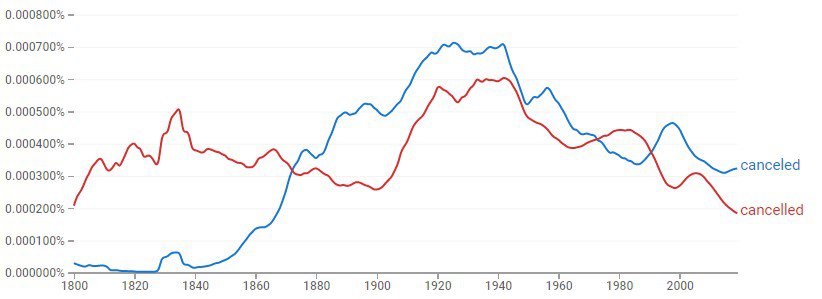
Every bit the Ngram below shows, American English has just recently adopted the one-l spellings of canceled,canceling, etc., and the alter is non fully engrained in the American language. In web searches of American publications roofing the last couple of years, cancelled and cancelling all the same appear about once for every five instances of canceled and canceling. Outside the U.S., meanwhile, the one-lspellings announced only very rarely. This is true even in Canada, which is usually friendlier to American spelling idiosyncrasies than is the residual of the English-speaking globe.
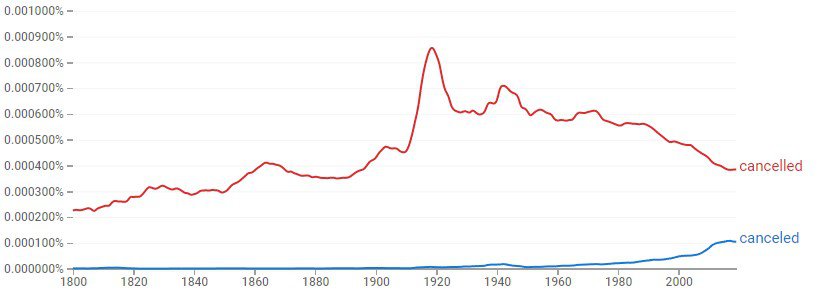
Like Ngrams for British books (shown below)testify the one-fiftyforms kickoff to gain ground in British English—likely due to the strong American influence on spider web-only publications from effectually the world—but the two-lforms still prevail past a large margin.
Spelling Exception: Cancellation
Now that you know the difference between canceled and cancelled, let's talk well-nigh cancellation. This word is a spelling exception considering it's the standard term in American and British English.
No matter who your audience is, apply cancellation instead of cancelation. Take a look at these examples:
- British Airways suggested rescheduling instead of a flight cancellation.
- I'm disappointed virtually the cancellation of Beyonce's concert.
- You better become if y'all don't want to pay a cancellation fee of £80.
- An disparateness is a proper term for the cancellation of a matrimony.
- She requested a cancellation of the effect because she was afraid of being cancelled.
Cancelable or Cancellable
Cancelable, with 1 L, is the adjectival form of cancel and is the preferred spelling in American English. Cancellable with ii 50's, is the preferred spelling outside of the U.Due south.
Does Canadian English Use Canceled or Cancelled?
Canadian English language uses two L'south when spelling cancelled, cancelling etc. American and Canadian accents might sound the aforementioned, just their writing styles in English language are very distinct.
Canadian English besides uses other longer words equally a spelling rule. It adopts "ou" in words similar humour, behaviour, and romour. And they prefer "er" instead of "re," as in centre and theatre.
Canadian Example
Student groups say organizers of the Canadian Grand Prix overreacted in cancelling the free opening day of the event. [CBC]
Does Australian English language Use Canceled or Cancelled?
Australians besides spells the discussion with a double 50 similar Canadian and British spellings. Australian English uses cancel, cancelled, cancelling, and cancellation. Australians besides spell humour instead of sense of humour and favourite instead of favorite.
In Conclusion
Both canceled and cancelled are acceptable varieties of English, right spellings, and accept the same definitions. However, American English language employs the version with a single L, while British English prefers double L. The primal to avoiding whatsoever confusion is remembering that Americans use simpler spelling.
Call back to consider who your target audience is before using canceled or cancelled. Otherwise, people might cancel you!
Source: https://grammarist.com/spelling/cancel/
0 Response to "Which Is Correct"
Post a Comment