Definition of Product an Appropeat Example of Digital Art

Irrational Geometrics digital art installation 2008 by Pascal Dombis
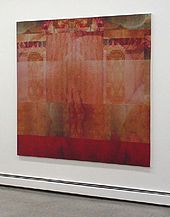
Joseph Nechvatal nascency Of the viractual 2001 estimator-robotic assisted acrylic on sail
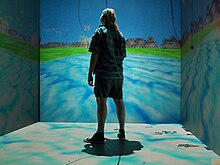
Digital art is an artistic work or practice that uses digital applied science as part of the artistic or presentation process. Since the 1960s, diverse names have been used to describe the procedure, including computer fine art and multimedia art.[1] Digital art is itself placed under the larger umbrella term new media fine art.[2] [3]
After some initial resistance,[4] the bear upon of digital technology has transformed activities such as painting, literature, drawing, sculpture and music/audio art, while new forms, such as net art, digital installation fine art, and virtual reality, have become recognized artistic practices.[v] More generally the term digital artist is used to describe an creative person who makes apply of digital technologies in the production of art. In an expanded sense, "digital art" is gimmicky art that uses the methods of mass production or digital media.[6]

The techniques of digital art are used extensively by the mainstream media in advertisements, and by picture-makers to produce visual effects. Desktop publishing has had a huge impact on the publishing world, although that is more related to graphic blueprint. Both digital and traditional artists apply many sources of electronic data and programs to create their work.[7] Given the parallels betwixt visual and musical arts, information technology is possible that general acceptance of the value of digital visual art volition progress in much the aforementioned way as the increased acceptance of electronically produced music over the terminal iii decades.[8]
Digital art can be purely computer-generated (such as fractals and algorithmic art) or taken from other sources, such as a scanned photograph or an prototype drawn using vector graphics software using a mouse or graphics tablet.[9] Though technically the term may be applied to art done using other media or processes and just scanned in (from scanography ), it is commonly reserved for art that has been not-trivially modified by a computing process (such as a computer programme, microcontroller or whatever electronic system capable of interpreting an input to create an output); digitized text information and raw sound and video recordings are non unremarkably considered digital fine art in themselves, simply can be office of the larger project of reckoner art and information art.[10] Artworks are considered digital painting when created in a like fashion to non-digital paintings merely using software on a calculator platform and digitally outputting the resulting paradigm as painted on canvass.[11]
Andy Warhol created digital art using a Commodore Amiga where the computer was publicly introduced at the Lincoln Center, New York in July 1985. An image of Debbie Harry was captured in monochrome from a video camera and digitized into a graphics programme called ProPaint. Warhol manipulated the image adding color by using alluvion fills.[12] [13]
Amidst varied opinions on the pros and cons of digital technology on the arts, in that location seems to exist a stiff consensus within the digital art community that information technology has created a "vast expansion of the creative sphere", i.e., that it has greatly broadened the creative opportunities available to professional and non-professional artists akin.[14]
Whilst 2D and 3D digital art is beneficial every bit it allows preservation of history that would otherwise take been destroyed by events similar natural disasters and war, there is the issue of who should ain these 3D scans - i.due east. who should own the digital copyrights.[15]
Computer-generated visual media [edit]

Digital visual art consists of either 2nd visual data displayed on an electronic visual display or information mathematically translated into 3D information, viewed through perspective projection on an electronic visual display. The simplest is 2D computer graphics which reflect how you might draw using a pencil and a piece of paper. In this example, even so, the epitome is on the figurer screen and the instrument you draw with might be a tablet stylus or a mouse. What is generated on your screen might appear to be drawn with a pencil, pen or paintbrush. The second kind is 3D computer graphics, where the screen becomes a window into a virtual environment, where you arrange objects to be "photographed" by the computer. Typically a second computer graphics use raster graphics as their primary means of source data representations, whereas 3D calculator graphics employ vector graphics in the creation of immersive virtual reality installations. A possible tertiary paradigm is to generate art in 2nd or 3D entirely through the execution of algorithms coded into computer programs. This can be considered the native fine art course of the computer, and an introduction to the history of which is bachelor in an interview with estimator art pioneer Frieder Nake.[xvi] Fractal art, Datamoshing, algorithmic art and real-time generative art are examples.
Figurer generated 3D still imagery [edit]
3D graphics are created via the process of designing imagery from geometric shapes, polygons or NURBS curves[17] to create 3-dimensional objects and scenes for use in various media such equally film, television, print, rapid prototyping, games/simulations and special visual furnishings.
At that place are many software programs for doing this. The engineering tin enable collaboration, lending itself to sharing and augmenting by a creative try similar to the open up source movement, and the creative commons in which users tin interact in a project to create fine art.[18]
Popular surrealist creative person Ray Caesar works in Maya (a 3D modeling software used for digital animation), using it to create his figures equally well every bit the virtual realms in which they exist.
Reckoner generated blithe imagery [edit]
Computer-generated animations are animations created with a computer, from digital models created by the 3D artists or procedurally generated. The term is ordinarily applied to works created entirely with a calculator. Movies make heavy utilize of reckoner-generated graphics; they are called computer-generated imagery (CGI) in the film industry. In the 1990s, and early on 2000s CGI advanced enough and then that for the beginning time it was possible to create realistic 3D computer animation, although films had been using extensive calculator images since the mid-70s. A number of modern films have been noted for their heavy apply of photo realistic CGI.[nineteen]
Digital installation art [edit]
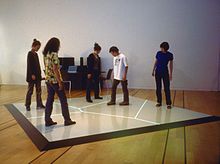
Digital installation art constitutes a broad field of activeness and incorporates many forms. Some resemble video installations, particularly large scale works involving projections and live video capture. By using projection techniques that enhance an audition'due south impression of sensory envelopment, many digital installations attempt to create immersive environments. Others go even further and attempt to facilitate a complete immersion in virtual realms. This blazon of installation is by and large site-specific, scalable, and without fixed dimensionality, pregnant it tin exist reconfigured to accommodate unlike presentation spaces.[21]
Noah Wardrip-Fruin'due south "Screen" (2003) is an example of interactive digital installation art which makes use of a Cavern Automatic Virtual Environs to create an interactive feel.[22] Scott Snibbe'south "Boundary Functions" is an case of augmented reality digital installation art, which responds to people who enter the installation past drawing lines between people indicating their personal space.[twenty]
Digital fine art and blockchain [edit]
Blockchain, and more specifically NFTs, have been associated with Digital Art since the NFTs craze of 2022 and 2021. While the applied science received many critics and has many flaws related to plagiarism and fraud (due to its about completely unregulated nature),[23] auction houses similar Sotheby'south, Christie's and various museums and galleries in the world started collaborations and partnerships with digital artists, selling NFTs associated with digital artworks (via NFT platforms) and showcasing those artworks (associated to the respective NFTs) both in virtual galleries and real life screens, monitors and TVs.[24] [25]
Fine art theorists and historians [edit]
Notable art theorists and historians in this field include Oliver Grau, Jon Ippolito, Christiane Paul, Frank Popper, Jasia Reichardt, Mario Costa, Christine Buci-Glucksmann, Dominique Moulon, Robert C. Morgan, Roy Ascott, Catherine Perret, Margot Lovejoy, Edmond Couchot, Fred Woods and Edward A. Shanken.
Subtypes [edit]
- Art game
- ASCII art
- Chip art
- Computer art scene
- Computer music
- Crypto art
- Cyberarts
- Digital illustration
- Digital imaging
- Digital literature
- Digital painting
- Digital photography
- Digital poetry
- Digital sculpture
- Digital compages
- Dynamic Painting
- Electronic music
- Evolutionary fine art
- Fractal art
- Generative art
- Generative music
- GIF fine art
- Immersion (virtual reality)
- Interactive art
- Internet art
- Motion graphics
- Music visualization
- Photo manipulation
- Pixel fine art
- Render art
- Software art
- Systems art
- Textures
- Tradigital art
Related organizations and conferences [edit]
- Artfutura
- Artmedia
- Austin Museum of Digital Fine art
- Reckoner Arts Society
- EVA Conferences
- Los Angeles Eye for Digital Art
- Lumen Prize
- onedotzero
- V&A Digital Futures
Come across besides [edit]
- Algorithmic fine art
- Computer art
- Reckoner graphics
- Electronic fine art
- Generative art
- Graphic arts
- New media art
- Theatre of Digital Fine art
- Virtual art
References [edit]
- ^ Reichardt, Jasia (1974). "20 years of symbiosis between fine art and science". Art and Science. XXIV, (1): 41–53.
- ^ Christiane Paul (2006). Digital Art, pp. 7–8. Thames & Hudson.
- ^ Lieser, Wolf. Digital Art. Langenscheidt: h.f. ullmann. 2009, pp. xiii–xv
- ^ Taylor, G. D. (2012). The soulless usurper: Reception and criticism of early on figurer art. In H. Higgins, & D. Kahn (Eds.), Mainframe experimentalism: Early digital calculating in the experimental arts. Berkeley, CA: University of California Press
- ^ Donald Kuspit The Matrix of Sensations VI: Digital Artists and the New Artistic Renaissance
- ^ Charlie Gere Art, Fourth dimension and Technology: Histories of the Disappearing Torso (Berg, 2005). ISBN 978-1-84520-135-vii This text concerns artistic and theoretical responses to the increasing speed of technological development and operation, especially in terms of so-called 'existent-fourth dimension' digital technologies. It draws on the ideas of Jacques Derrida, Bernard Stiegler, Jean-François Lyotard and André Leroi-Gourhan, and looks at the work of Samuel Morse, Vincent van Gogh and Malevich, amidst others.
- ^ Frank Popper, Art of the Electronic Age, Thames & Hudson, 1997.
- ^ Charlie Gere, (2002) Digital Culture, Reaktion.
- ^ Christiane Paul (2006). Digital Art, pp. 27–67. Thames & Hudson.
- ^ Wands, Bruce (2006). Art of the Digital Historic period, pp. 10–eleven. Thames & Hudson.
- ^ Paul, Christiane (2006). Digital Art, pp. 54–60. Thames & Hudson.
- ^ 'Reimer, Jeremy (Oct 21, 2007). "A history of the Amiga, part 4: Enter Commodore". Arstechnica.com . Retrieved June 10, 2011.
- ^ YouTube. Archived from the original on 2009-05-07.
- ^ Bessette, Juliette, Frederic Fol Leymarie, and Glenn West. Smith (xvi September 2019). "Trends and Anti-Trends in Techno-Fine art Scholarship: The Legacy of the Arts "Auto" Special Issues". Arts. 8 (3): 120. doi:x.3390/arts8030120.
{{cite journal}}: CS1 maint: uses authors parameter (link) - ^ Sydell, Laura (21 May 2018). "3D Scans Assistance Preserve History, But Who Should Ain Them? 2018". NPR. Archived from the original on 2022-01-xviii. Retrieved 7 February 2021.
- ^ Smith, Glenn (31 May 2019). "An Interview with Frieder Nake". Arts. 8 (2): 69. doi:10.3390/arts8020069.
- ^ Wands, Bruce (2006). Art of the Digital Age, pp. 15–16. Thames & Hudson.
- ^ Foundation, Blender. "About". blender.org . Retrieved 2021-02-25 .
- ^ Lev Manovich (2001) The Language of New Media Cambridge, Massachusetts: The MIT Press.
- ^ a b "Boundary Functions"
- ^ Paul, Christiane (2006). Digital Art, pp 71. Thames & Hudson.
- ^ "screen - noah wardrip-fruin".
- ^ "Does NFT Fine art Take A Identify In The Museum In 2022?". jingculturecommerce.com.
- ^ "Natively Digital: A Curated NFT Sale". sothebys.com.
- ^ "Beeple sold an NFT for $69 million". theverge.com.
External links [edit]
-
 Media related to Digital art at Wikimedia Commons
 - Dreher, Thomas. "History of Calculator Art"
- Zorich, Diane G. "Transitioning to a Digital Earth"
Source: https://en.wikipedia.org/wiki/Digital_art
0 Response to "Definition of Product an Appropeat Example of Digital Art"
Post a Comment